
How Do I Know How Many Flowers I’ll Need?
Oct 02, 2026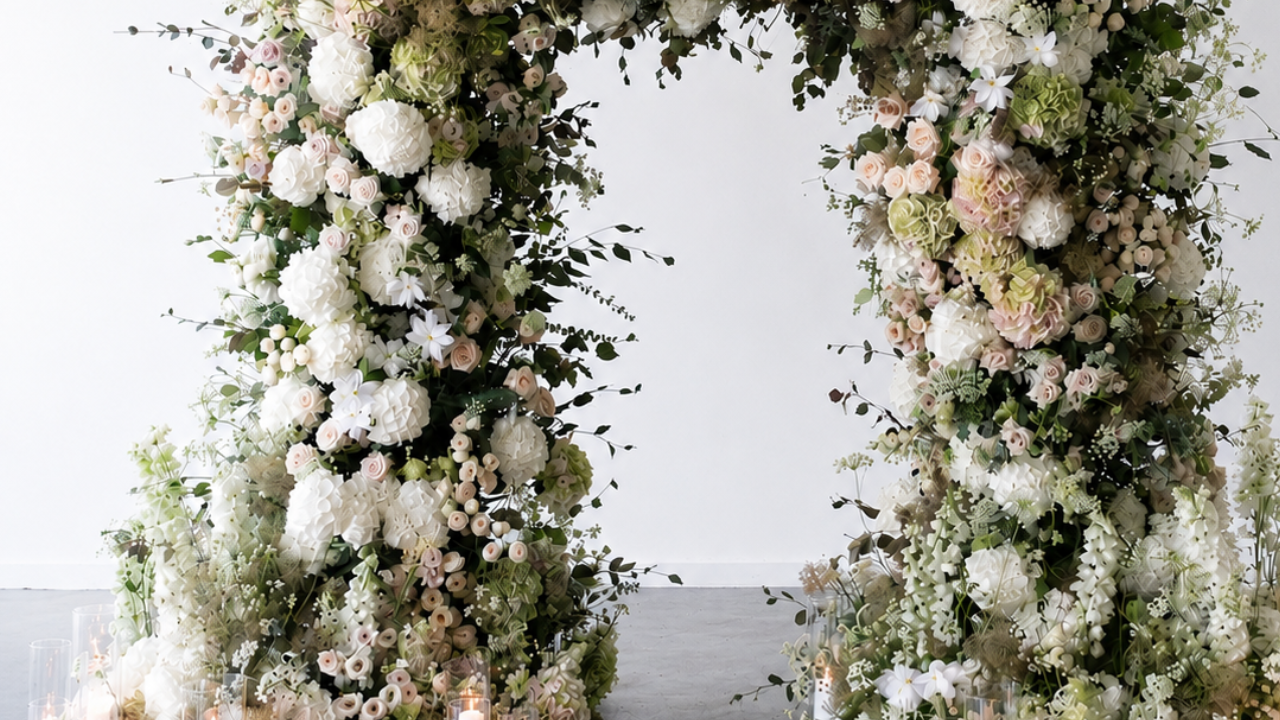
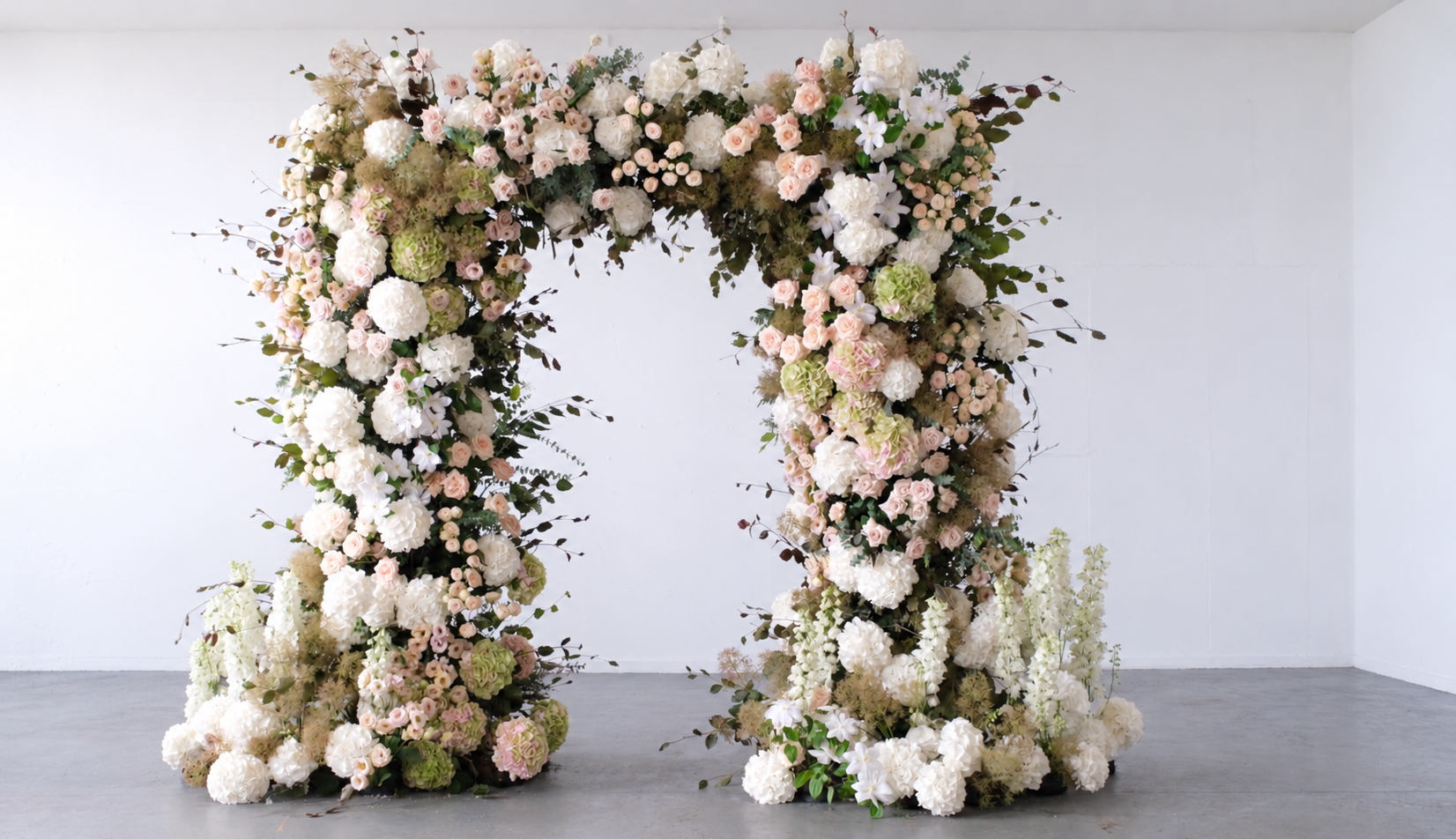
Image: 'The Luxury Archway' from The Installations Masterclass inside The Flower Class Membership
I wanted to share a question that came up during a recent Coaching Call inside Flower Class, because I suspect quite a few florists will recognise it. One of our members had been asked to quote for a foliage-filled backdrop, 3 metres by 2.2 metres, and she wasn't sure how to work out what she'd need to order. It's a question that tends to come up with larger work, whether that's a big foliage wall, a long run of flowers down a table, an archway or a hanging installation. You can usually picture how you'd like it to look and you have a fair idea of the density you're after, but then you reach the slightly less glamorous part, which is deciding how much to buy.
I'd love to tell you there's a formula, but I don't think there is one. Every design is different and every material behaves differently, so a loose, airy backdrop will use something quite different from a dense, abundant one, even when the measurements are identical. What I'd do instead is make a sample.
Build a small section first
Taking the foliage backdrop as an example, rather than looking at the whole thing and trying to guess, I'd buy a selection of the foliages I wanted to use, mark out an area of roughly one metre by one metre, and build that section at the density I wanted for the finished piece. Once I was happy with how it looked, I'd count up what I'd actually used.
You might find that one square metre takes five bunches of one foliage, three of another and two of something else. Whatever your recipe turns out to be, you now have something real to work from instead of a calculation you're trying to hold in your head. The backdrop from our Coaching Call comes to 6.6 square metres, so you'd scale your recipe up by that much, and you'd have a sensible starting point for your order.
Break the big job into smaller ones
The same thinking works for most large-scale work. If you have a 30-metre run of tables to flower, work out what one metre takes and go from there. For a large archway, make a manageable section first, and for a hanging installation, see whether there's a part of the design you can build and cost before you order for the whole thing.
I find this is where people often make life harder than it needs to be, because they try to solve the entire design in one go. A six-metre wall of foliage feels enormous, whereas a single square metre is something you can get your head around quite easily. You'll also learn things from the sample that you'd never have worked out on paper. One foliage might give you far more coverage than you expected, another might disappear completely once it's mixed in, and you may decide you need fewer varieties than you first thought, or that the whole piece wants more texture. It's much better to find that out before you've ordered six times as much of everything.
It helps with your costing too
Large-scale floral work can become expensive very quickly, and guessing quantities because something looks about right is a rather risky way to quote for a job. Once you've made a sample, you have a far better idea of what the materials cost and how much work goes into creating that amount of coverage.
It won't answer everything, of course. Six metres of installation won't necessarily take exactly six times as long as one metre, and there's usually plenty more to think about, such as structure, transport, access, staffing and installation time. But it gives you a sensible place to begin, and that's often all you need to start putting a quote together with some confidence.
Leave yourself a little room
I'd always add a bit extra, perhaps around 10%. I wouldn't want to over-order wildly, but I also wouldn't build an installation around the assumption that every bunch will be identical and every stem will be perfect. Some bunches are fuller than others, some stems turn out not to be usable, and every so often a material simply doesn't behave the way you expected. You might also change your mind once you're on site and can see the design in the space, and having a little in reserve means you can act on that without panicking. I think of it as contingency rather than waste.
It gets easier with practice
Each time you work this way, you learn something you can use again. Once you've made one substantial foliage backdrop, you'll have a much better idea of what that scale really requires, and the same goes for long tables, arches and hanging pieces. Over time you build up your own understanding of what certain materials do, how far they go and how much labour different types of work take. You won't suddenly know the answer to every job that lands in your inbox, and I don't think you need to. What you become better at is knowing how to work the answer out.
Where this question came from
I like questions like this one because they're rarely theoretical. They usually belong to a real wedding, a real quote or a design somebody is trying to make work. The monthly Coaching Calls in Flower Class can take in all sorts of things, from looking at a piece a member has created, to talking through the mechanics for an upcoming installation, to working out something practical like this. There are more than 350 lessons inside Flower Class, along with all five of my Signature Masterclasses, but once you start putting all of that into practice, new questions naturally appear, and sometimes what helps most is having somewhere to bring the thing that's sitting in front of you and ask how someone else would approach it.
If you'd like to see what's included, you can take a look below.
And if you're currently looking at a quote for something you've never made before, try not to work the whole thing out in your head. Make a small part first, and once you have something real in front of you, I think you'll find the numbers become much easier to understand.
I hope this helps! 
Artist. Educator. Writer. Broadcaster.


