
A Garden Under Glass in the Height of Summer
Jun 26, 2026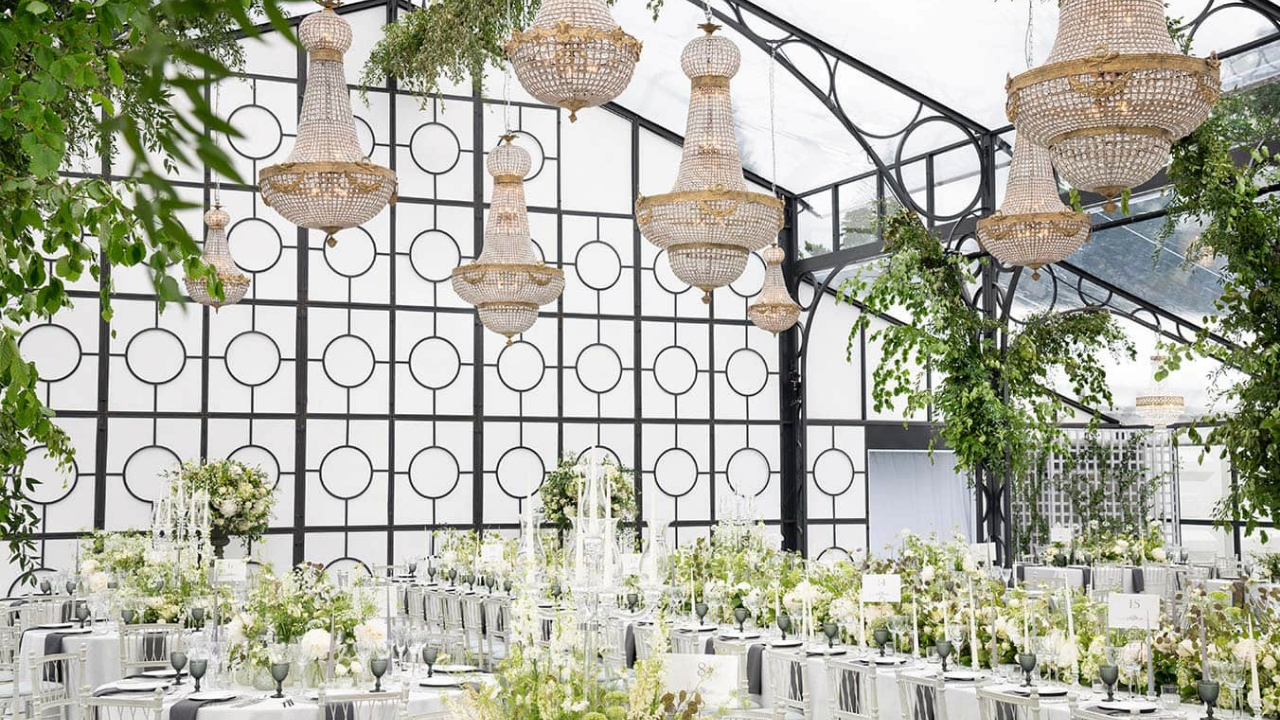
Image - The Garden Under Glass Wedding Installation
It’s story time, welcome.
A few years ago, a wedding planner approached me with a rather extraordinary brief.
The couple were planning a very large wedding inside a custom-built glass marquee, set within the old walls of a crumbling castle and surrounded by beautiful gardens.
They wanted the flowers to feel as though the garden had simply continued growing inside.
Not themed. Not overdone. Not a marquee filled with random greenery.
It needed to feel tasteful, curated and completely at home within the setting, almost as though the castle had fallen away, the glasshouse had flourished in its place and nature had carried on doing what it does.
It was a beautiful idea!
The greenery would climb the structural posts, travel across the beams and gather overhead to create a loose canopy.
With living trees inside the marquee, large urn installations, flowers throughout the tables and a garden built around a stone fountain.
There were also temporary partition walls which needed to disappear into the design, with flowers growing yo and across them.
Naturally, it was not a small job.
The ceilings were so high that we needed a cherry picker to install the foliage overhead, and the whole thing was going to take us the best part of a week.
This was also happening at the height of summer, inside what was essentially an enormous greenhouse, while my team and I had other wedding work happening around it.
So the question was not only, “Can we create this?”
It was, “How on earth are we going to keep it looking beautiful until the wedding on Saturday?”
Inside Flower Class, Joseph shares the mechanics, planning and design thinking behind ambitious floral installations, alongside hundreds of lessons designed to help you grow your skills and confidence.
The practical bit nobody sees
During the planning, it was suggested that the marquee might not have air conditioning.
Nope!
We were being asked to install large quantities of flowers, foliage and living trees over several days, inside a glass structure in the middle of summer.
Then to add lighting (huge chandeliers), catering, musicians, staff and eventually a full room of guests, and the temperature was only ever going to go in one direction.
There is no flower food, conditioning trick or clever mechanic that can make cut flowers stay fresh while sitting inside what is essentially a greenhouse.
If the couple wanted the scale and abundance we'd designed, then some form of cooling had to become part of the plan.
Thankfully, the wedding planner understood.
Air-conditioning units were brought in, and custom joinery was even created to hide them so they didn’t interrupt the look of the room - cute!
It's not the most glamorous part of floral design, but it's absolutely essential and that's quite often the case with large wedding installations.
The finished work is supposed to look effortless, but behind it there are usually so many practical conversations about access, temperature, timings, water, weight, lifting equipment and whether the ceiling will actually hold what you are hoping to attach to it.
Building the garden
Because the installation was taking place over several days, we didn’t have every flower and piece of foliage delivered at once.
I made sure that deliveries were staggered, so we had the materials we needed when we needed them.
The stronger foliage and the materials needed for the earlier, more structural parts of the installation arrived first.
The more delicate flowers came later, closer to the point when we were actually going to use them.
It meant we weren't cramming buckets full to save space, and it meant the flowers that needed to look particularly fresh for the wedding arrived much closer to the day itself.
It sounds fairly obvious when I say it now, but on a job of that size, the delivery schedule becomes part of the design process too.
There are only so many buckets. There's only so much room.
And not every flower needs to spend an entire week sitting at the venue before anybody sees it.
Over the course of the week, the marquee slowly began to change.
The trees came in first and helped establish the scale of the room.
Then the foliage began climbing the posts and moving across the beams above us.
The fountain was surrounded with plants and cut flowers (very pot-et-fleur) until it felt as though a garden had grown around it.
The urn installations were built, the tables were dressed and the partition walls gradually disappeared beneath hundreds of individual stems - and a LOT of test tubes.
There were ladders everywhere, mechanics being hidden, buckets moving in and out, people working at different heights and a cherry picker making its way through the room.
It was busy.
Very busy.
But little by little, all of that activity began to disappear behind the finished work.
By the end of the week, it felt as though the gardens outside had properly taken over the marquee.
Which was exactly what we wanted.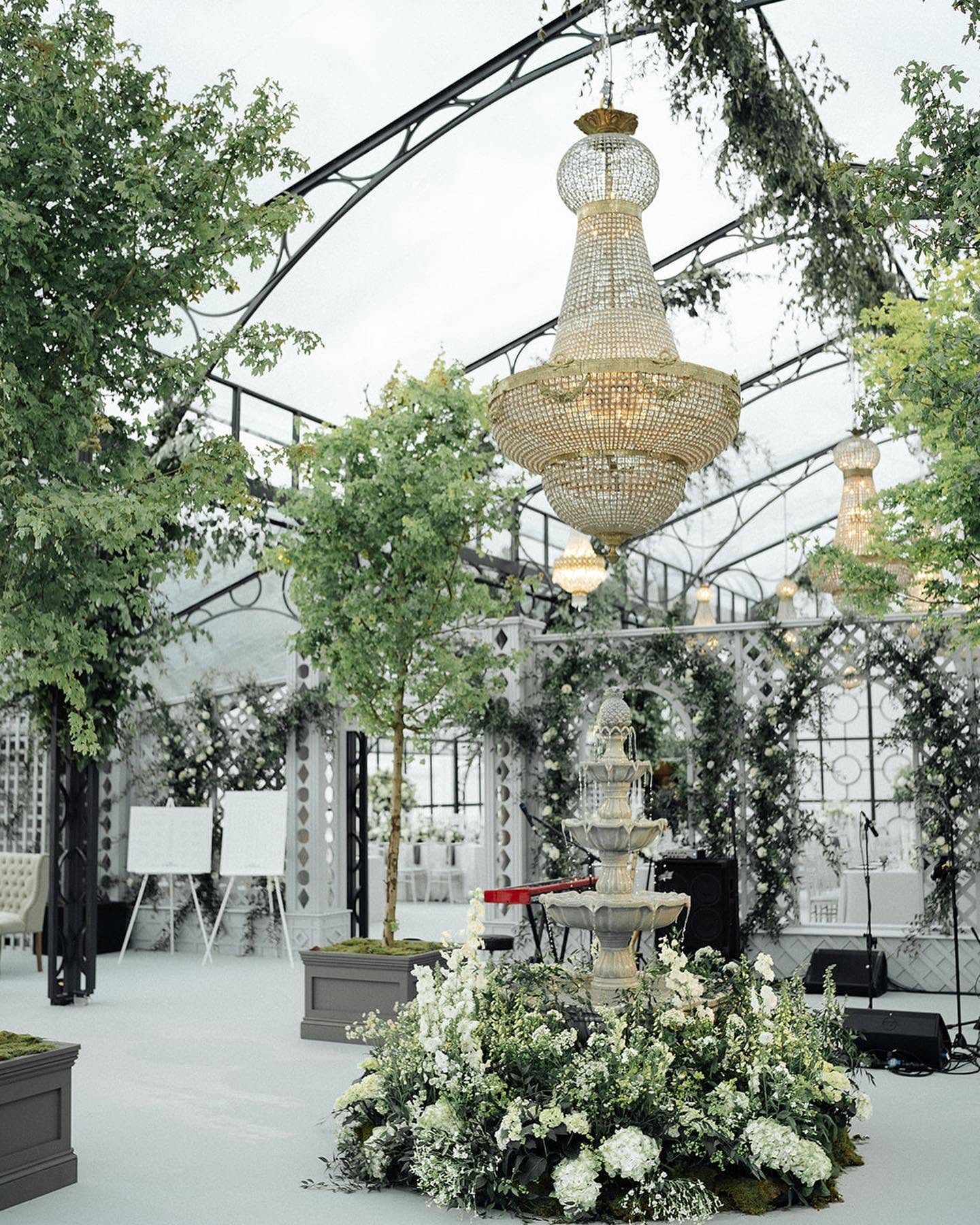
Nearly right is not quite right
The wedding was taking place on the Saturday.
By Friday evening, the room was very nearly complete.
The trees were in place, the urns were looking beautiful, the fountain had become part of the garden and the flowers were moving through the room in exactly the way we had hoped.
But ... some of the foliage we'd installed earlier in the week had started to struggle.
The air conditioning had helped enormously, but in a few places it had also dried the materials out.
Elsewhere, the summer heat had begun to catch the edges of the leaves.
The room still looked beautiful.
Most people probably wouldn't have noticed.
But it wasn’t quite right, and when you have spent the best part of a week creating something on that scale, “nearly right” is not really where you want to leave it.
So, late on the Friday night and into the early hours of Saturday morning, once the temperature had finally dropped, we went back through the installations and refreshed the foliage.
Sections were taken out.
New materials were brought in.
Areas that had started to tire were rebuilt before the guests arrived.
It was one of those last-minute scrambles that nobody attending the wedding would ever know had happened.
And that is rather the point.
The guests arrived on Saturday and saw trees, urns, flowers climbing the walls, greenery moving across the ceiling and a fountain surrounded by a garden.
They didn't see the cherry picker, the buckets, the staggered deliveries, the hidden air-conditioning units or the team replacing foliage in the middle of the night.
Nor should they have.
What do you do when the weather is working against you?
I suppose the reason this wedding came back to me this week is because it has been so incredibly warm here in the UK, and several of our Flower Class members have been asking how they can get the best from their flowers in this sort of weather.
It’s a question I’m asked every summer, and it’s one I still have to think about myself.
Because however long you’ve worked with flowers, the heat doesn’t suddenly become easy.
You might have a much better idea of which materials are likely to cope, how long they need to drink, when they ought to be delivered and which flowers should be left until the last possible moment, but you’re still working with something living.
Sometimes it behaves exactly as you expect it to.
Sometimes it doesn’t.
On that particular wedding, we had thought very carefully about the cooling, the deliveries, the order in which everything would be installed and which materials needed to arrive later in the week.
We had good flowers, a very experienced team and an enormous amount of planning behind us.
But it didn't quite all go to plan.
There isn’t a magic product that will make every flower behave beautifully in every condition, and I’m always slightly wary when floristry advice begins to sound as though there is.
For me, it comes back to the fairly unglamorous basics.
Buy the best materials you can. Condition them properly and as soon as they arrive. Use clean buckets, clean tools, fresh water and professional flower food. Give everything enough time to drink, keep it as cool as you reasonably can and don’t ask the most delicate flowers to sit in place for hours longer than they need to.
Then keep looking at them.
That last part matters enormously.
You can plan every detail, but you still need to notice when something is beginning to struggle and be prepared to change it.
Sometimes that means moving a design, sometimes it means adding something later, and sometimes it means returning to a marquee in the middle of the night and replacing foliage before anybody else sees it.
Experience doesn’t mean that nothing ever goes wrong.
It means you are slightly more likely to see it coming, and hopefully rather better equipped to deal with it when it does.
By the time the guests arrived on the Saturday, the room looked exactly as we had hoped it would.
They saw the trees, the flowers, the fountain and the greenery growing up into the roof.
They didn’t see the buckets, the cherry picker, the hidden air-conditioning units or the foliage that we had been replacing only a few hours earlier.
And, really, that's how it should be.
Ready to create work on a larger scale?
Inside Flower Class, you’ll find Joseph’s complete Installations Masterclass, where he shares the design thinking, mechanics, planning and practical decisions behind creating ambitious floral installations with confidence.
You’ll also have access to hundreds of floral design and business lessons, monthly coaching, downloadable resources and all five of Joseph’s Signature Masterclasses.
Explore Flower Class Here.
Artist. Educator. Writer. Broadcaster.


