
On Tomatoes, Floral Fashions, Old Ideas and Why I’m Still Completely Obsessed
Aug 15, 2026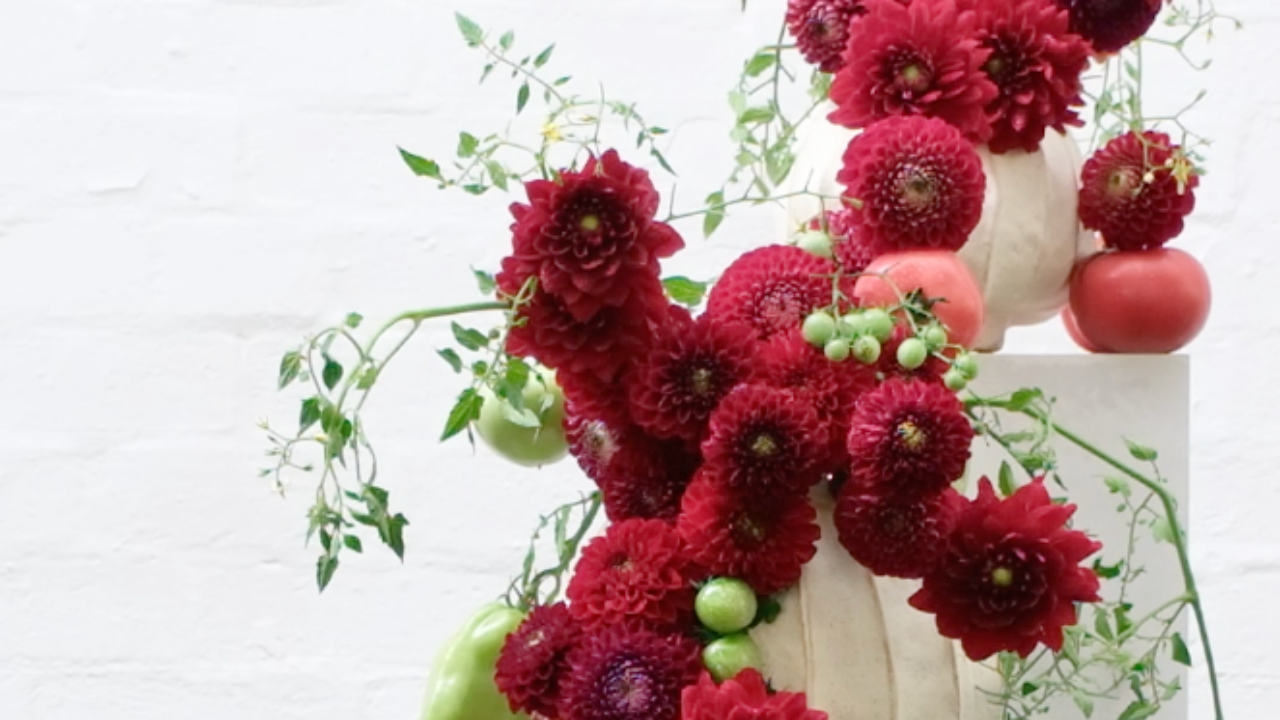
Image - Tomato Abundance
Follow your curiosity.
It's something I've been thinking about a lot this summer, particularly as mine has apparently led me deep into tomato greenhouses.
A lot of my recent work has been influenced by fresh fruit. Strawberries, cherries, blackberries and, increasingly, tomatoes. There's something about seeing these familiar ingredients away from the kitchen that makes me look at them completely differently.
The tomatoes have probably been the most fun. I knew I wanted to work with a real spectrum of colours, shapes, forms and textures, rather than simply buying a few punnets from the supermarket and hoping for the best. So, to get the goodies, I went back to Lyncroft, an organic fruit and vegetable farm just outside my hometown of Liverpool. I'd first visited earlier in the year to harvest rather a lot of black kale for a few floral designs, and I'd been itching for an excuse to return. This time, it was tomatoes.
I picked kilos of them fresh from the vine, in all sorts of colours, sizes and wonderfully strange shapes. Some came back to the studio still attached to the vine, which was exactly what I'd hoped for.
And this, I think, is one of the things I love most about following an idea properly. You start with a fairly simple thought, in this case, I'd like to work with tomatoes, and then curiosity starts asking questions of its own. What varieties are out there, what happens if you leave them on the vine, and can something so familiar suddenly feel surprising? Before you know it, you're standing in a greenhouse surrounded by tomatoes and feeling enormously pleased with yourself.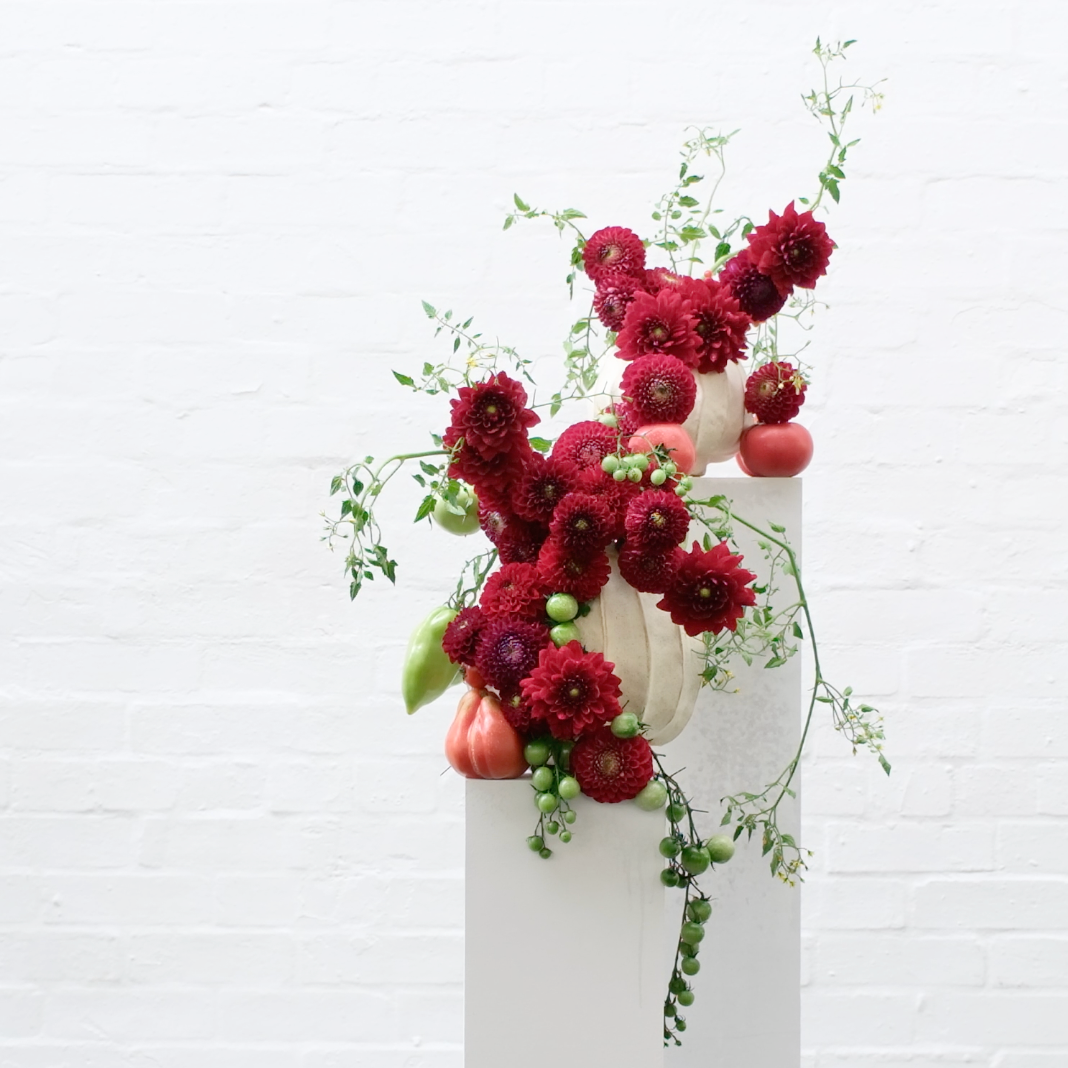
The resulting designs, to me, look and smell like summer.
And that's really where my current fruit and vegetable obsession comes from. I'm interested in materials that immediately communicate something. A ripe tomato, a handful of strawberries or a blackberry branch already carries with it a sense of season, place and familiarity before I've added a single flower.
As florists, we become very tuned into the subtleties of seasonal flowers. We know that narcissi feel like spring, dahlias take us somewhere entirely different, and a fresh summer hydrangea has a completely different character to the wonderful papery heads we might use later in the year. But not everybody speaks that floral language quite as fluently as we do.
Everybody understands a tomato. A strawberry says summer. Blackberries tell you that summer is beginning to turn. Apples and pears start nudging us towards autumn. Citrus brings another feeling entirely. It's a language we all speak.
And I think that's one of the reasons fruit and vegetables can be such useful ingredients for a florist. They don't just give us another colour, texture or form, they can make seasonality immediately recognisable to somebody who might not know one variety of hydrangea from another. There's familiarity there, but there's also surprise. Taking something somebody knows intimately and putting it somewhere they weren't expecting to see it can make them look again. A strawberry amongst roses, radicchio sitting proudly in the middle of a bowl, Cavolo Nero invited to dinner, or a tomato vine weaving its way through a floral arrangement.
And of course, every time I become convinced I've stumbled across some brilliantly contemporary new idea, floristry history has a rather effective way of putting me back in my place. Last month, while researching for a very exciting but currently top-secret project, I was looking through a Jane Packer book from the early 2000s and spotted rhubarb being used in a floral design. I was devastated. There I'd been, congratulating myself for seeing those incredible pink sticks of forced rhubarb earlier this year and thinking, now that would look cool amongst flowers, only to discover Jane had beaten me to it by a couple of decades.
Naturally, I issued a very public apology on Instagram for ever giving the impression I was the first florist in human history to look at rhubarb and think it might belong in an arrangement. And unfortunately for me, it gets worse. Constance Spry was already using rhubarb, artichokes, spinach, kale and all sorts of unexpected ingredients decades before either of us. So it turns out I wasn't twenty years late, I was closer to eighty.
But actually, I rather love that. I don't think creativity is always about finding something nobody else has ever thought of before, that's a fairly impossible standard to set yourself. Sometimes it's simply about encountering a familiar material at exactly the right moment and suddenly seeing another possibility in it. And it really does go to show that all fashions - floral or other - always have a way of coming back around.
Perhaps you've walked past tomatoes a thousand times. Perhaps you've cooked with rhubarb every spring of your life. Perhaps there's a cabbage sitting in the vegetable drawer right now that has never once struck you as remotely inspiring. And then one day you look again, and that's the bit I find exciting.
Fruit and vegetables are particularly wonderful for this because they're accessible, seasonal and endlessly varied. You don't necessarily need a specialist wholesaler, a particularly generous flower market or access to some obscure botanical treasure. Inspiration might be sitting at the greengrocer, growing at a local farm or waiting beside tonight's dinner. There's something quite liberating about knowing that an ingredient costing a few pounds might be the thing that sparks your next idea.
There are now well over a dozen centrepiece lessons inside Flower Class where I've found an excuse to bring fruit or vegetables into the mix, so apparently this curiosity has been going on for some time. A Very Strawberry Centrepiece, Cavolo Nero for Dinner, The Radicchio Bowl, The Vitamin C Centrepiece and A Petite Berry Bowl are just a few of them.
And as we turn our attention to centrepieces inside Flower Class this month, I'm particularly interested to see where everybody else's curiosity leads them. We have members joining us from all over the world, and when we gather for our live Coaching Call later this month, I'm particularly excited to see what's seasonal elsewhere, and what you have access to that I might never think to reach for here in Manchester. Perhaps it'll be berries here in Britain, citrus somewhere warmer, something tropical I can't easily get my hands on, or a fruit or vegetable I've never once considered inviting into a floral design before.
Because the ingredient doesn't have to be new, and the idea probably doesn't have to be new either, as Jane Packer and Constance Spry have now rather firmly established for me. You just have to be curious enough to look again.
So perhaps that's the challenge this month. Look again at the market stall, the fruit bowl, the vegetable drawer, and if something makes you stop and think, right then, what can I do with you, pick it up. You never know where it might lead you. Occasionally, that might be deep into a tomato greenhouse.
Feeling curious?
Artist. Educator. Writer. Broadcaster.


