
The Secret to Creating More Open, Airy Hand-Tied Bouquets
Oct 09, 2026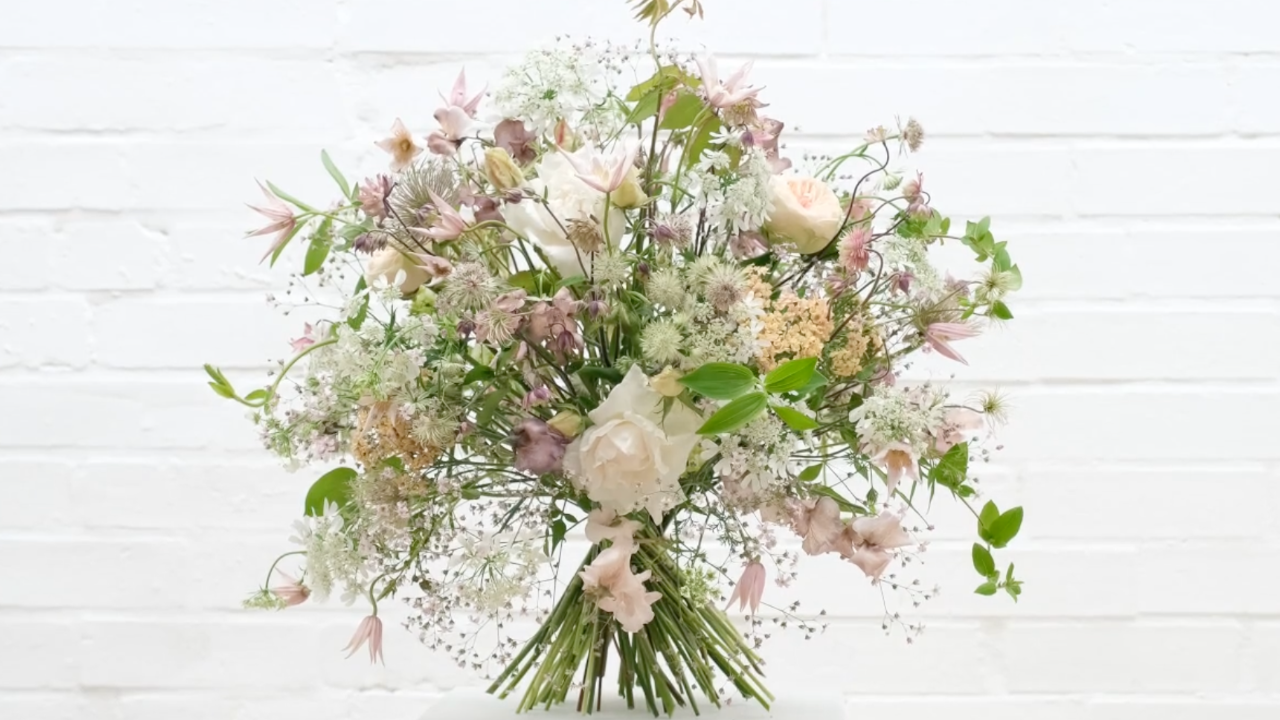
Image: 'The Scramble Hand Tied Bouquet' from The Flower Class Membership
When we want a bouquet to feel generous, abundant or luxurious, there’s a natural temptation to add more flowers. More stems, more ingredients, more volume. But sometimes the thing that makes the greatest difference isn’t adding anything at all.
It’s creating more space around what you already have.
One of the techniques I use for this is something I call The Scramble, and it has become one of my favourite ways to make open, airy hand-tied bouquets. It’s a simple framework that sits within the bouquet and lets the stems be positioned with more room between them, rather than gathering tightly together in your hand. The technique itself is rather clever, but I think the more interesting part is the principle behind it, because as floral designers we spend a great deal of time thinking about the flowers we put in and far less about the spaces we leave between them.
Giving Every Flower Room to Breathe
Think about why you chose those particular flowers in the first place. Perhaps it was the arching movement of a stem of clematis, the almost weightless quality of astrantia, or the character of a garden rose. When flowers are packed very closely together, we often lose the very qualities that made us choose them. The arching stem gets buried amongst its neighbours, the delicate flower disappears into a mass of colour, and the lines and shapes we picked so carefully become much harder for the eye to appreciate.
Give those same ingredients a little more space and you begin to notice them one by one. You see the curve of a stem and the negative space between one flower and the next, and you can create movement through the bouquet rather than simply building a solid mass. There’s absolutely a place for dense, abundant design, and I love a generous mass of flowers as much as anyone, but being able to choose how open or compact a bouquet feels is an incredibly useful skill. That’s where a little understanding of mechanics can make all the difference.
A Little Technique I Call The Scramble
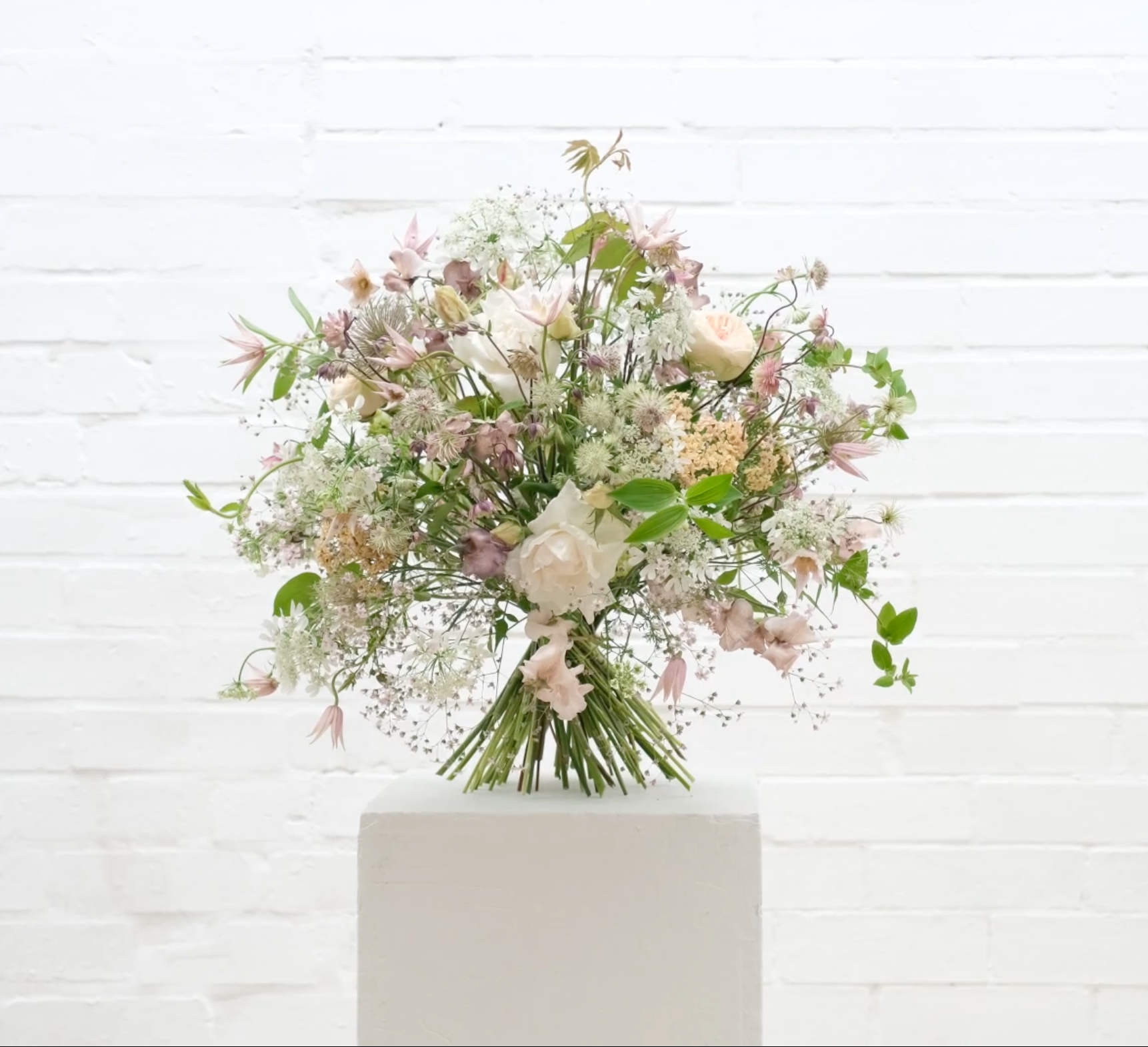
The Scramble Hand-Tied Bouquet, from the Flower Class Membership.
If you’ve worked in floristry for any length of time, you’ll probably know the little egg of chicken wire that many florists tuck inside a hand-tied bouquet to help support the stems. The Scramble works on a similar idea but goes about it quite differently. It’s a lightweight framework with plenty of open space built into it, and it even has its own handle, which makes the whole thing feel connected and secure in your hand in a way an egg never quite does.
Once it’s sitting within the bouquet, it gives you a structure to position your flowers through, rather than relying entirely on the stems to support one another. That extra control means you can make much more deliberate decisions about where every ingredient sits and, just as importantly, where it doesn’t. It takes only a couple of minutes to make, costs a few pence in materials, and can be prepared well in advance, which for such a simple thing I find rather wonderful.
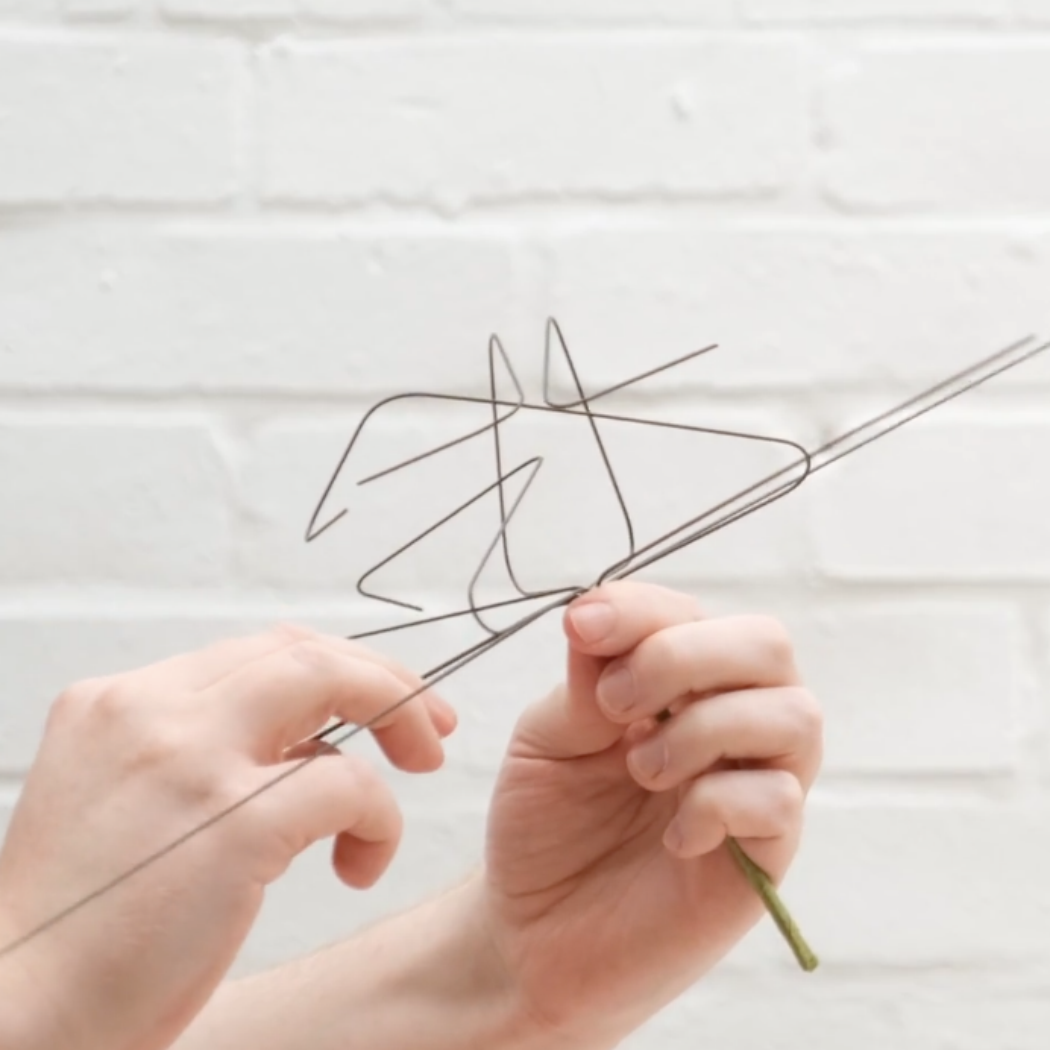
The Scramble framework, as taught inside Flower Class.
Why This Matters Beyond the Beauty of the Bouquet
You know I’m as interested in the business practicalities of floristry as I am in the beauty of it, and that’s another reason The Scramble has become such a favourite. A handful of well-placed stems can create a surprisingly expansive silhouette, and a particularly lovely ingredient can shine without being surrounded by lots of extra material. Space can help a relatively modest collection of flowers carry considerably more presence.
I should be honest that this doesn’t necessarily mean using fewer flowers. The bouquet I make in Flower Class contains over 100 stems, many of them small and delicate, and it still reads as light and open. What the technique gives you is control over the silhouette and the overall impression your materials create, and the more control you have, the more confidently you can make decisions about your flowers, your time and your costs.
Something to Try in Your Next Hand-Tied Bouquet
The next time you’re making a hand-tied bouquet and it begins to feel a little dense, rather than reaching straight for another flower, take a moment to look at what you’ve already got. Could those stems be given a little more room? Could you create a pocket of space between two ingredients? Could one beautiful stem sit slightly apart from the others instead of disappearing into the crowd?
You don’t need every bouquet to be enormous or wildly open, and that isn’t really the point. What I’d like you to take from this is that space is something we can design with, just like colour or form. Sometimes another flower is exactly what a bouquet needs, and sometimes a little less flower and a little more space makes the whole thing feel like considerably more.
Explore The Scramble Inside Flower Class
The Scramble and The Scramble Hand-Tied Bouquet are both lessons inside Flower Class, my online floral education membership. In the first, I show you how to make the framework itself, and in the second I build the whole bouquet step by step, including the flower choices and how I prepare them. If you’d like to explore more of the techniques, mechanics and design thinking we cover inside Flower Class, you can take a closer look below.
And in the meantime, the next time a bouquet feels as though it’s missing something, perhaps don’t add another stem straight away. See what happens when you give the flowers you’ve already chosen a little more room to breathe.
Until next time,
Artist. Educator. Writer. Broadcaster.


