
Brand, Product and Consumer Alignment: The Foundation of a Stronger Wedding Flower Business
May 29, 2026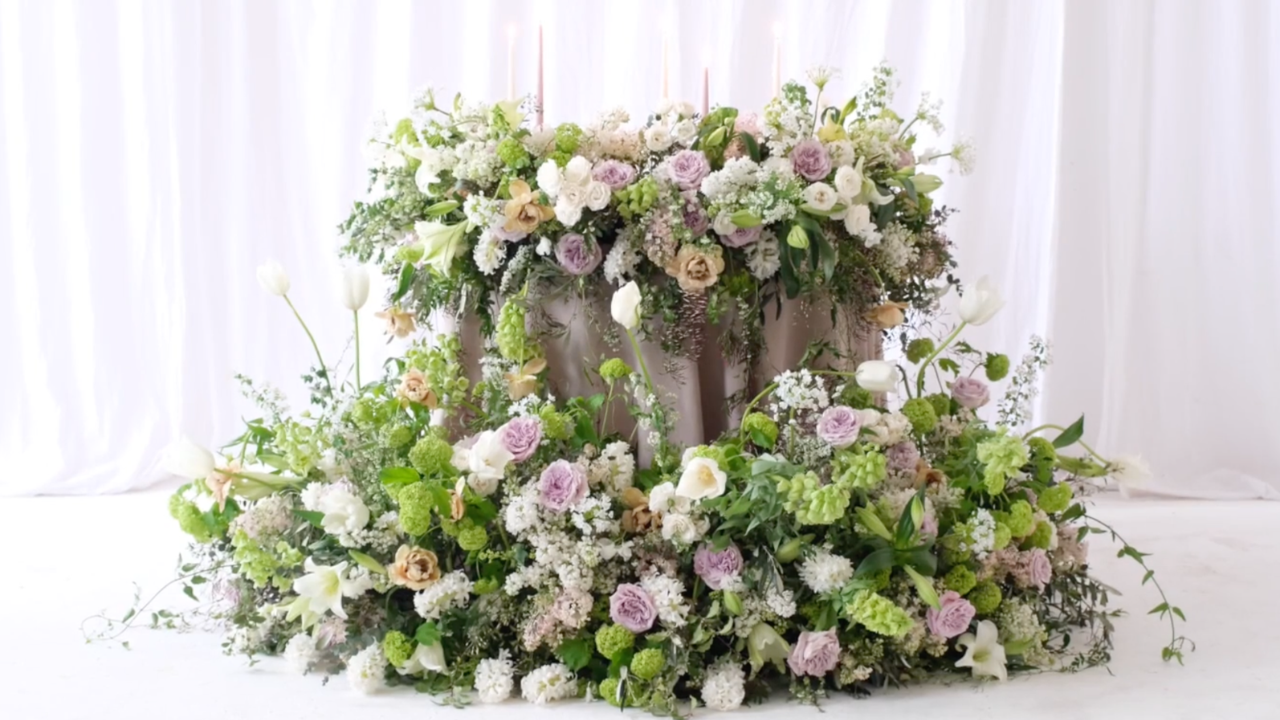
Image - The Meadowscape Sweetheart Table
When you start a wedding flower business, or when you’ve been in business for a little while, chances are you’ll naturally begin to receive a few enquiries enquiries. They might come from friends, from family, from past customers, from people who have seen your work somewhere and thought, “Oh, you do weddings, don’t you?”
And that’s lovely. Of course it is.
But it can also be a pretty hit and miss way to build a business.
In this day and age, when the world feels a little bit more uncertain and business feels a little bit more costly to run, I don’t think we want to leave quite so much to chance. The more intentional we are about what we’re doing in our business, the better.
Wedding flowers are a service. A very good service, a very useful service, and a very meaningful service in people’s lives. But they don’t necessarily sell themselves. You can’t simply put a small note on your website, add a line to your Instagram bio, or mention once in passing that you offer wedding flowers and expect to immediately start booking the kind of weddings you truly want to book.
Most florists and floral designers are already making lovely work. You might know the techniques. You might know how to condition flowers, create a bouquet, dress a table, build an arch, or make something beautiful with your hands. But the real question is : how do we get the best out of those wedding services?
How do we engineer the system?
How do we put the right foundations in place so that we’re not just hoping the right clients find us, but actively creating a business that attracts more aligned enquiries, better bookings, stronger sales and more creative fulfilment?
For me, that begins with one of the most important foundations of all: brand, product and consumer alignment.
What alignment really means
Those of you who have trained with me before, either in person or online, will know that I do talk a lot about alignment. And I know that alignment can sound like quite an elastic concept. It can sound a little vague, perhaps even a little airy fairy, depending on where you’ve heard it before.
But in business, alignment is deeply practical.
When I talk about alignment, I’m talking about flow. I’m talking about ease. I’m talking about creating a business where one part logically supports the next. Your brand supports your product. Your product makes sense to your consumer. Your consumer understands, values and wants what you offer.
Nothing is fighting against itself. Nothing feels clunky. Nothing feels like you’re constantly trying to persuade the wrong people to buy something they don’t really understand.
And I’m a pragmatic person. Those of you who have trained with me in person will know this for sure. I like actionable steps. I like things that are rooted in what we can actually do, one step after the other, to improve our businesses and, therefore, our lives.
So when we talk about brand, product and consumer alignment, we’re not talking about something mystical. We’re talking about three essential parts of your wedding business.
Your brand is who you are, what you stand for, how you communicate, and the world you invite people into.
Your product is what you actually sell. In this case, that might be your wedding flowers, your installations, your bouquets, your table designs, your styling, your creative process, your service, your eye, your experience and your expertise.
Your consumer is the person at the end of it all. The couple. The client. The person who is going to trust you, book you, pay you, and invite you into one of the most emotionally charged days of their life.
When those three things sit in perfect, harmonious alignment, something rather wonderful starts to happen. Your business begins to make more sense. Your enquiries feel better. Your consultations become easier. Your proposals are more likely to land. Your work becomes more creatively fulfilling, and rather importantly, more financially viable too.
That is the sweet spot.
It’s not about chasing a high end label for the sake of it. It’s not about ego. It’s not about deciding you want to be a luxury wedding florist simply because somebody online told you that’s where the money is. It’s about finding the intersection between what you love to make, what people want to buy, and the customers you actually want to serve.
And that’s a really important distinction.
Ditch the traditional ideal client avatar
Many of us have been taught to think first about the client. We’re told to build an ideal client avatar, to imagine what magazine they read, what car they drive, where they shop, where they go on holiday, what coffee they order, and whether their imaginary dog has a charmingly aristocratic name.
And I’m sure there’s a place for some of that. Somewhere.
But I think we need to go deeper than that.
Rather than building a stiff, corporate ideal client avatar, start by asking who you genuinely want to serve. Not who you think you should serve. Not who the florist down the road is serving. Not who Instagram has decided is the most aspirational client this week.
Who do you want to work with?
What do they value?
Do they value artistry? Do they value trust? Do they value seasonality? Do they value sustainability? Do they want to be guided by someone with expertise, or do they want to micromanage every stem? Do they understand that flowers are not just decoration, but atmosphere, emotion, softness, scent, movement and memory?
Once you begin to understand that person, you can start to build a consumer profile that is actually useful. Think about the kind of wedding they would book. The venue they might choose. The suppliers they might be drawn to. The atmosphere they might want to create. The way they might want their guests to feel.
Then look back at your own business and ask the harder question.
Does my brand currently speak to them? Does my product make sense to them? Does my portfolio show the kind of work they would want to buy? Does my website reassure them? Does my enquiry process make them feel welcomed, calm and excited?
Does the whole experience of my business feel aligned with the kind of client I’m trying to reach?
If those things don’t line up, you’ll feel it. Perhaps not immediately, and perhaps not in a way you can neatly diagnose, but you’ll feel the friction. You’ll feel it in the enquiries that go nowhere. You’ll feel it in the consultations that feel heavy. You’ll feel it in the weddings that drain more energy than they return. You’ll feel it when you keep designing things that don’t really feel like you, simply because that’s the work that keeps arriving.
And there’s no judgement in that. Most of us have taken work because we needed the work. We’ve all had bills to pay, rent to cover, flowers to order, staff to look after, and moments where the practical needs of the business have had to come first.
But if your whole business is built around work that drains you, then something needs to change.
The creative inventory check
This is where I think a creative inventory check can be incredibly helpful. Take a hard, honest look at the weddings you currently have in the diary, or the weddings you’ve delivered over the last year or two, and ask yourself if they are really in alignment with what you want to be doing.
Does the work feel creatively fulfilling? Does it feel financially fulfilling? Does it make sense for the business you want to build? Does it speak to the clients you want to attract next?
You’ll usually know the answer quite quickly. I’m a big believer in listening to your gut, or your belly, in a strange sort of way. Often, your body has already understood what your spreadsheet is still trying to explain. You know when something feels off. You know when a job looks good on paper, but doesn’t actually make sense for the direction you want to move in.
That doesn’t mean the work is bad. It doesn’t mean the clients are bad. It doesn’t mean you’ve failed. It simply means your business might be asking for a little more clarity.
And clarity is powerful.
Because when you know who you are, what you make, and who you serve, the rest of your business becomes easier to shape. Your pricing becomes easier to explain. Your portfolio becomes easier to curate. Your social content becomes easier to create. Your website becomes easier to write. Your sales process becomes easier to build.
It all begins to flow from the same place.
For florists who want to go much deeper into the creative and commercial foundations of wedding floristry, this is exactly the kind of work we explore in The Wedding Masterclass.
The aim is not simply to make beautiful wedding flowers, although of course that matters enormously. The aim is to build a wedding flower business with stronger systems, clearer thinking and more confidence behind the work.
Your brand is your boundary
Your brand is not just a logo, a font, a colour palette or a nice looking website. Your brand is the line between what you stand for and what you don’t. It shows the type of work you want to create. It communicates the values behind that work. It gives people a sense of whether they belong in your world.
Over time, as your reputation grows, as your portfolio develops, as your testimonials build, as your social media presence becomes stronger and your digital footprint expands, your brand begins to filter people. It attracts the clients who are right for you, and gently filters out those who are not.
And that is not a bad thing.
In fact, it’s one of the most useful things a strong brand can do.
You don’t need every enquiry. You need the right enquiries. You need clients who understand the work, value the process, respect the budget, trust your eye, and feel genuinely excited by the kind of flowers you want to make.
A clear brand helps those people find you. It also helps the wrong people realise, quite peacefully, that perhaps you’re not the right fit for them. That saves everyone time. It saves energy. It saves you from writing proposals for people who were never going to book. It saves you from twisting your work into shapes that don’t feel good.
And really, it helps you build the business you actually want to build.
This is why style matters so much, too. Not style in a superficial way, but style as a living expression of your values, your hands, your influences, your instincts and your way of seeing the world.
Inside Flower Class, the lesson Curating Your Authentic Style is a beautiful place to begin if you’re trying to understand what feels most true to you creatively, and how that can begin to shape the way your business presents itself.
Permission to pivot
If you’re reading this and realising that perhaps the business you have now isn’t quite the business you want in the future, that’s useful information. Maybe you’re not serving the customer you truly want to serve. Maybe you’re not making the work you most want to make. Maybe it’s not creatively fulfilling. Maybe it’s not financially fulfilling. Maybe it was right for a season, but it’s not right forever.
And if that’s the case, you can pivot.
I know pivot is a very 2020 word, and I think we’ve all heard it enough for one lifetime, but it’s true. Just because you have one business today, that doesn’t mean it’s the business you always need to have. It can be the starting point for the business you want to build next.
You might have begun by taking every wedding you could because you needed the experience, the photographs, the testimonials and the confidence. That’s perfectly reasonable. I did it in the beginning too. Most businesses begin with a certain amount of saying yes. But as your skills grow, as your confidence grows, and as your reputation grows, your business is allowed to become more discerning.
You’re allowed to say, “This is the kind of work I want to be known for.”
You’re allowed to say, “This is the kind of client I work best with.”
You’re allowed to say, “This is the level of service I offer, and this is what it costs.”
That isn’t arrogance. It’s alignment.
And the more clearly you understand your brand, your product and your consumer, the easier those decisions become.
Alignment gives you a framework. It helps you know what to say yes to, what to say no to, and which opportunities are simply distractions dressed up as possibilities.
The intersection of joy and profit
If you have a really clear idea of who you are and what you stand for, a really clear idea of the products and services you want to offer, and a crystal clear idea of who it is you want to serve, your business will move more easily.
You’ll be able to identify the opportunities that are for you and the opportunities that are not. You’ll save money. You’ll save time. You’ll save creative energy.
And perhaps most importantly, you’ll begin to build a wedding flower business that feels good from the inside, not just impressive from the outside.
That, to me, is the intersection of joy and profit.
It’s not just about booking more weddings for the sake of more weddings. It’s about booking the right weddings. It’s about creating work that feels rich, intentional and alive, while also building a business that is commercially sound. It’s about making sure your flowers, your pricing, your process, your communication, your portfolio, your website and your client experience are all pointing in the same direction.
That direction doesn’t have to look like anybody else’s.
It just has to be yours.
So before you start worrying about whether you need to post more on Instagram, rebuild your website, rewrite your enquiry form, or overhaul your entire sales process, begin here.
Ask yourself who you are as a brand.
Ask yourself what you actually want to make.
Ask yourself who you most want to serve.
And then ask yourself where those three things are currently out of alignment.
Because once you can answer those questions honestly, the next steps become much clearer. Your portfolio becomes easier to curate. Your social content becomes easier to create. Your website becomes easier to write. Your sales process becomes easier to shape.
It all begins to flow from the same place.
And in a wedding flower business, that kind of clarity is not just helpful. It’s essential.
Artist. Educator. Writer. Broadcaster.


