
The Portfolio Overhaul: How to Build a Wedding Flower Portfolio That Actually Sells
Jun 05, 2026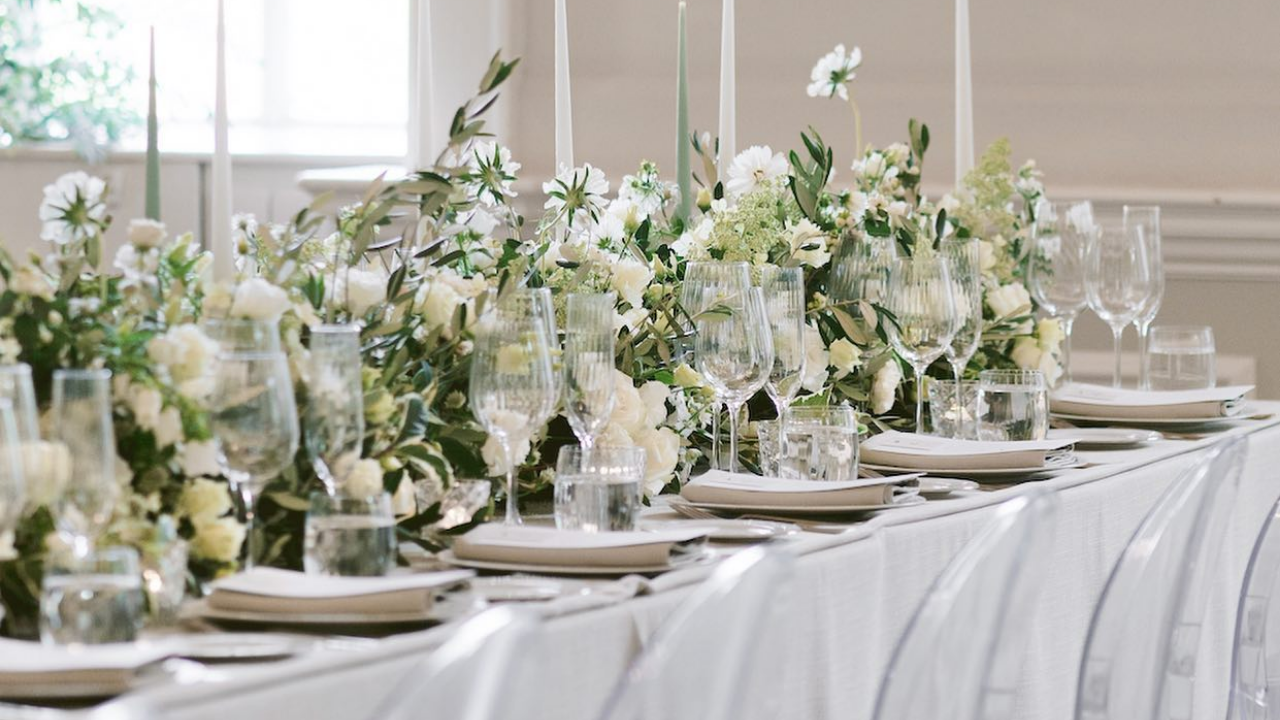
Image - A Refined Edinburgh Wedding Tablescape
When you begin to have a clearer sense of who you are as a brand, what you want to make, and who you most want to serve, the next question is very simple.
Does your portfolio actually prove it?
Because if you’re a wedding or event florist, your portfolio is not just a nice collection of images. It’s not a pretty scrapbook of the weddings you’ve done. It’s not a digital attic filled with every bouquet, buttonhole, centrepiece, archway, urn and floral meadow you’ve ever created, all bundled together to prove that you’ve been busy.
Your portfolio is your number one selling tool.
And I really do mean that. Especially if you’re not working from a retail flower shop, if you’re working from home, from a studio, or building your wedding business online, your portfolio has to work incredibly hard for you. It has to show people who you are before they’ve spoken to you. It has to show them what you make, what you value, how you see flowers, how you approach design, and what kind of experience they might be able to trust you to create for one of the most important days of their lives.
So yes, of course, it needs to be beautiful. This is flowers & floral design. Beauty matters. But it also needs to be strategic.
A strong portfolio should not simply record where you’ve been. It should sell where you’re going next.
Your portfolio needs to work harder than you think
In most cases, your portfolio is going to be primarily online. It might be on your website, a dedicated gallery, a beautiful lookbook, or a private page that you send to prospective clients after an enquiry. But I also think it could be useful to have a PDF version available to email, and, depending on how you work with clients, a printed version can still be incredibly powerful in person. There can be something rather lovely about sitting with a client and turning the pages together, particularly if you’re speaking about larger weddings, more luxurious work, or a very considered design process.
But whatever format you choose, the work itself has to be current. It has to be reviewed and refreshed after each season. It has to show a wide enough range of your work to build confidence, without becoming so broad that it loses clarity.
This is where many florists get themselves into a tangle, because they think a portfolio has to show everything.
It doesn’t.
It has to show the right things.
The question is not, “Have I included everything I’ve ever made?” The question is, “Does this portfolio help the right client understand what I can do for them?” That is a very different way of thinking, and it’s often the difference between a portfolio that simply stores images and a portfolio that actively helps you sell.
A great portfolio has three parts
A great portfolio, to my mind, has three key parts. It needs the Heart Stoppers, the Heart, and the Heartfelt.
It sounds simple, but it gives the whole thing structure. It stops your portfolio becoming a random pile of images and turns it into something with movement, rhythm and purpose. It allows a client to feel the impact of your work, understand the substance of your offer, and then connect with the more intimate, emotional details that make weddings so personal.
Heart Stoppers
The Heart Stoppers are those first few pages, those opening moments, those images that make someone stop.
These are the emotive, magical, atmospheric shots. The room shots. The impression shots. The images that show the whole feeling of a wedding, not just the flowers in isolation. Perhaps it’s the ceremony room just before guests arrive, with flowers climbing around the doorway and candles waiting to be lit. Perhaps it’s the dining space, glowing in the late afternoon light, with flowers running down the tables and the whole room feeling abundant, generous and alive. Perhaps it’s the kind of photograph that makes a client imagine themselves inside that world.
These images matter enormously because they create desire. They don’t just show what you made. They show what it felt like.
And that distinction is incredibly important.
A client does not just want to buy a bowl of flowers, or an urn, or a bouquet. They want to buy the feeling those flowers create. They want atmosphere. They want emotion. They want beauty. They want the moment their guests walk into the room and feel something.
So your first few pages should not be polite. They should not be timid. They should not begin with a slightly blurry buttonhole from 2018 because you feel loyal to it.
The first few pages need to do some heavy lifting.
They need to say, "this is the world we create".
Heart
Then comes the Heart of the portfolio.
This is your selling space.
This is where you show the work in more detail, and it’s where you build trust. Here, you want to include your centrepieces, your bouquets, your core wedding flowers, and the designs that help a client understand the breadth of what you can offer. This part of the portfolio should show a range of budgets, a range of styles, a range of flowers and a range of seasons, but it should still feel completely aligned.
That’s the key.
A range does not mean chaos. A range does not mean every style under the sun. A range means showing that you can work with different briefs, different rooms, different budgets and different seasons, while still holding onto the thread of who you are as a florist.
So if you want to book elegant, garden inspired weddings, show that. If you want to work with seasonal British flowers, show that. If you want to create rich, abundant, candlelit tables, show that. If you want couples to trust you with colour, movement, texture and more expressive floral choices, your portfolio has to prove that this is a world you know how to build.
Because clients can only respond to what you show them.
They cannot read your mind. They cannot know that you are secretly desperate to create more dramatic ceremony flowers, more generous tablescapes, more interesting colour palettes, more sculptural installations, more foam free mechanics, or more of whatever it is that feels most true to the direction of your work. You have to show them.
What you show is what you invite.
Heartfelt
Then we come to the Heartfelt.
These are the more intimate moments. The personal flowers. The emotional images. The artistic shots. The black and white photographs. The little details that bring humanity and softness into the portfolio. A hand holding a bouquet. A veil catching against a flower. A parent pinning on a buttonhole. A bride holding flowers just before walking into the ceremony. A quiet table detail. A close up of a stem, a texture, a ribbon, a moment.
These images might not always sell scale, but they sell feeling.
And feeling matters.
Because weddings are not just logistical projects. They’re deeply emotional days. Yes, we need to be able to talk about budgets, mechanics, timings, transport, labour, proposals and profit. Of course we do. A wedding flower business has to function properly as a business. But the client is also buying emotion. They’re buying atmosphere. They’re buying the feeling of walking into a room and seeing something that feels completely, unmistakably theirs.
The Heartfelt section of your portfolio allows you to show that you understand that.
It softens the sales process. It gives the work tenderness. It reminds the client that flowers are not just decorative. They’re part of the memory of the day.
Show the full value of your offering
Somewhere within that portfolio, I would also include a page, a note, or a small section about rental options if you offer them. This doesn't need to become a giant catalogue (unless prop hire is a significant part of your business, of course) but clients do need to know what else is available.
Lanterns, candles, votives, vessels, plinths, stands, easels, arches, urns, bowls, tableware or any other pieces that support your floral work can become part of the conversation, and often part of the sale.
This is one of the reasons your portfolio should not be treated as something purely aesthetic. It has a commercial job to do.
If you offer rental items, show them beautifully. Don’t hide them away. Don’t assume the client will ask. They may not even know what’s possible until you show them. And when they see the flowers in context, with the candles, the vessels, the props and the room styling working together, it becomes much easier for them to understand the value of a more complete design service.
That’s where your portfolio begins to support your sales system.
It doesn’t have to shout. It doesn’t have to feel pushy. It simply has to show the client what’s possible and guide them clearly towards the next step.
Curate, don't collect
A good portfolio should feel intentional. It should not look as though someone has handed a prospective client a giant photo album of every floral design they have ever made and said, “Good luck in there. I hope you find something you like.”
We’ve all seen those portfolios. Far too many images. Far too many styles. Far too many weddings that feel as though they belong to completely different businesses. A blush and ivory barn wedding here, a tropical corporate dinner there, a rustic jam jar moment from 2014 sitting in the corner, wondering why it hasn't yet been released from service.
And listen, we’ve all been there.
In the early stages of a business, we often create work we don’t necessarily love because we need the experience, the revenue, the photographs, the testimonials, the confidence, or quite simply because we need to pay the bills. There is no shame in that. Business has practical realities. Flowers need buying. Rent needs paying. Life, rather rudely, continues to send invoices.
But as your business grows, your portfolio needs to grow with it.
It needs to become more selective. More refined. More confident.
A strong wedding portfolio does not need to be enormous. It needs enough images to show range, depth and credibility, but not so many that the client feels as though they’ve fallen into an endless scroll and may never again see daylight.
Less is more.
And yes, I realise that’s slightly ironic coming from someone who can talk for an Olympic length of time about a table centrepiece, but still, less is more.
Show the work you want to repeat
One of the most useful questions you can ask when reviewing your portfolio is this.
Would I be happy if someone booked me to create more work like this?
If the answer is yes, keep it in.
If the answer is no, think very carefully.
Because what you show is what you invite. If your website is full of work that no longer excites you, then it should not be a surprise when enquiries arrive asking for more of that work. If your portfolio shows every style under the sun, then it shouldn't be a surprise when the enquiries feel a little all over the place. If your images are not communicating the business you want to build, then they're not doing the job they could be doing and should be doing.
And if you don’t yet have the work you want to show, that’s when self initiated shoots can become so useful.
I am a very big believer in creating work for yourself, especially if you’re at the start of your business, or if you’re trying to move into a new style, a new market, or a new type of client. Self initiated shoots can be absolutely essential because they allow you to make work that points towards where you want to go, even before the right clients have found you.
By that, I don’t mean creating something fake, stiff or over produced that has no relationship to the kind of work you actually want to sell. I don’t mean copying another florist because their work performed well on Instagram. I mean giving yourself space to practice, experiment and show what your hands are capable of when no one else is setting the brief.
Some of the best work you will ever make might be the work you make for yourself.
When you create work for yourself, you get to explore. You can try the colour palette you’ve been thinking about for months. You can test a new mechanic. You can practice a shape that feels just outside your comfort zone. You can work with ingredients you love. You can create something that feels much closer to the direction you want your business to move in.
And, in doing so, you begin to figure out what feels like you.
Make the words work
Images matter enormously, of course. This is floristry. We’re working in a visual medium, and beautiful images will always carry a great deal of weight. But don’t underestimate the words around those images.
When you share galleries on your website, in a PDF, in your portfolio, or across social media, try to write like a real person. Not like a corporate brochure. Not like a robot, or an AI chatbot, who has recently discovered the phrase “quietly gentle bespoke floral solutions”. Not like someone trying to sound more impressive than they actually are.
Write with warmth, clarity and personality. Write like you.
Tell the story of the work. Talk about the atmosphere you're trying to create. Mention the flowers that made the design sing. Explain why a certain colour palette worked so well in the room. Share a small behind the scenes detail. Talk about the season. Talk about the venue. Talk about the way the flowers supported the feeling of the day.
This doesn't need to become a novel. We’re not trying to write War and Peace under every urn arrangement. But a little context can be incredibly powerful.
Writing can help a client understand not just what you made, but why it mattered.
And that builds trust.
Make the format work harder
Your portfolio can live on your website. It can be a downloadable PDF. It can be a printed book in your studio or shop. It can be a lookbook you send to prospective clients & planners. It can be part of your consultation process. It can even be split into different versions, depending on the work you offer.
If you create weddings and corporate events, for example, I wouldn't necessarily show both in the same portfolio. They're different clients, with different priorities, different emotional landscapes and different decision making processes. A wedding client wants to imagine the atmosphere of one of the most personal days of their life. A corporate client may be thinking about brand, guest flow, photography, visibility, logistics and return on investment.
Both deserve to be shown work that speaks directly to them.
And because we live in a digital age, your portfolio should not be passive.
If you’re sending a PDF, embed links. Link to your website. Link to your enquiry form. Link to your social media. Link to relevant galleries. Link to your prop hire page if you have one. Link to your process page so the client can understand how working with you actually unfolds.
Make it easy.
If someone sees something they love, don’t make them hunt for the next step. Don’t make them dig through your website like they’re taking part in some sort of floral escape room. Guide them clearly and warmly towards the action you want them to take.
Review Regularly
After all that work, please don’t create your portfolio once and abandon it for several years like a sad houseplant in the corner of the studio.
Review it regularly.
Before wedding season begins, take a proper look at it. At the end of the year, once the main season has slowed down and you can breathe again, take another look. Ask whether the work still feels aligned with where your business is going. Ask whether the images are strong enough. Ask whether the order makes sense. Ask whether the portfolio speaks clearly to the consumer you want to reach.
Remove anything that no longer fits. Add new work that feels more current. Refine the order. Update the language. Check the links. Make sure the whole thing still feels like you.
This doesn't have to become an enormous, dramatic task. It can simply become part of how you maintain the direction of your business. A seasonal check in. A moment to ask, “Is this still where I’m going?”
Because businesses evolve. Your taste evolves. Your confidence evolves. Your clients evolve. The work you want to be known for might change over time, and your portfolio should be allowed to change with it.
Just because a piece of work helped you get to one stage of your business does not mean it has to come with you into the next.
You can be grateful for it and still let it go.
Your portfolio should point forwards
A strong portfolio is not just about beautiful pictures.
It gives your business clarity. It shows the world what you make, but it also shows the world what you value. It helps prospective clients understand whether they’re in the right place. It gives them confidence in your eye, your skill and your experience. It explains the kind of work you want to create more of.
And perhaps, most importantly, it helps you stop leaving everything to chance.
So take a good, honest look at your portfolio.
Ask whether it reflects who you are now, not just who you were when the work was made.
Ask yourself if it speaks to the clients you most want to serve. Ask if it shows the work you most want to repeat. Ask if it feels like a sales tool, or simply a storage cupboard.
Because your portfolio is not just there to show that you’ve been busy.
It's there to show where you are going to next.

Artist. Educator. Writer. Broadcaster.


