
What can you do with the familiar?
Sep 28, 2026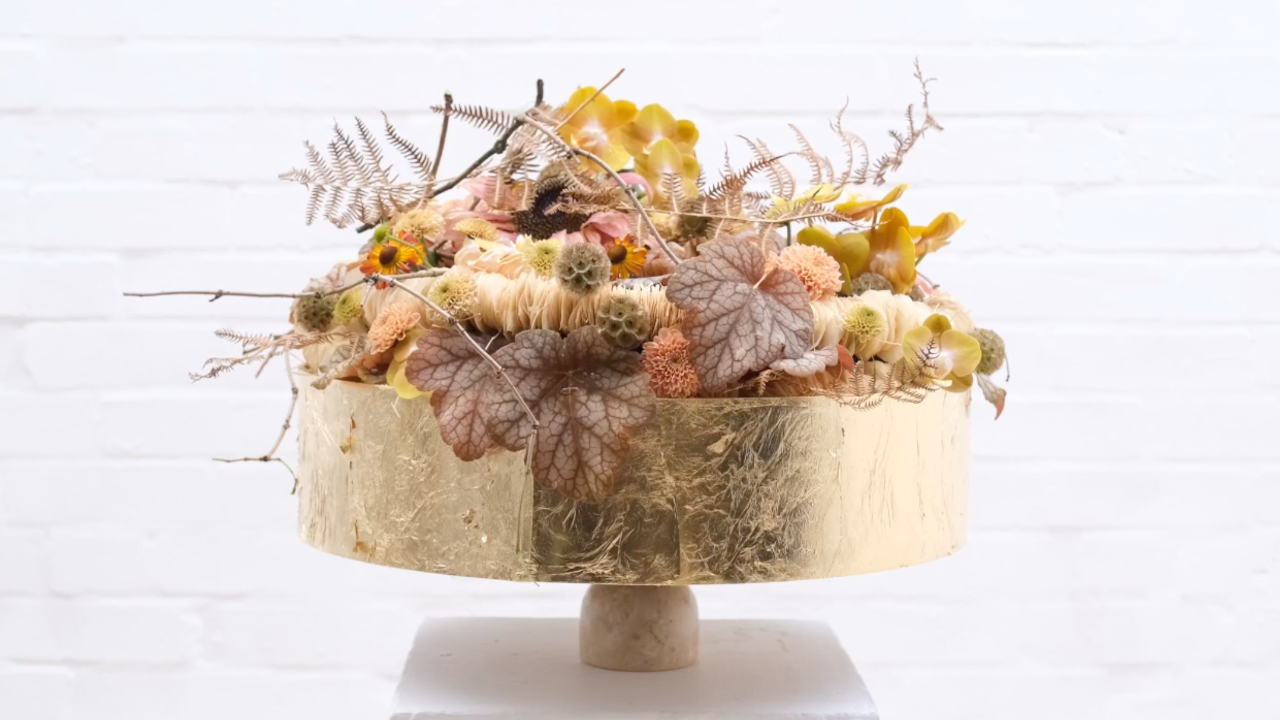
Image: 'Autumn Gold' from The Flower Class Membership
I’ve always believed that some of the most interesting floral ideas begin when we look at something familiar a little differently.
It doesn’t necessarily require an extraordinary flower, an elaborate mechanic or an expensive vessel. Sometimes it’s just a question of taking something we’ve seen or used countless times before and asking: "what else could I do with this?"
I think that question is particularly useful in floristry because, quite naturally, we tend to become familiar with certain formats. The vase arrangement, the hand-tied bouquet, the basket, the bowl, the table centre or the hatbox. We understand what they are supposed to look like, and after a while it can become very easy to approach them in much the same way each time.
But familiarity doesn’t have to mean predictability. Sometimes, it simply gives us a really good starting point.
Start by looking beyond what something was made for
One of the arrangements I’ve been teaching recently begins with something a little less glamorous than you might expect: an inexpensive lampshade from a discount homeware shop.
With a little gold leaf and some creative thinking, that lampshade becomes the framework for an abundant autumnal arrangement filled with hydrangea, chrysanthemums, sunflowers, orchids, helenium, seed pods, branches and dried materials. I called the finished piece October Gold, but the part I find most interesting isn’t really the finished arrangement. It’s the decision that came before it.
A lampshade wasn’t created to hold flowers, of course, but once you stop looking at it only as a lampshade, you begin to notice other things. Its shape, its proportions, the structure it gives you, the negative space within it and the way flowers might move through, around or beyond it.
Suddenly, something super ordinary begins to offer all of these possibilities.
It could just as easily be a planter, a bowl, a piece of homeware, an old container or something sitting unnoticed on a shelf. The point isn’t that we should all rush out and start arranging flowers in lampshades. It’s simply to get into the habit of asking what else an object might become.
Keep the principle, change the ingredients
Once the framework for October Gold was established, the flowers were built through it in layers. Lower materials created the foundation, stronger focal flowers drew the eye, and secondary flowers, branches and textural ingredients brought movement, colour and interest through the design.
Those are principles that can travel far beyond any one arrangement.
Although I filled this particular piece with those wonderful copper, bronze and autumnal tones, there is nothing particularly October-specific about the thinking behind it. Change the flowers, change the colour palette, change the season, change the scale. Keep the idea and make it yours.
That, for me, is where floral education becomes most useful. I’m far less interested in teaching someone to reproduce an arrangement exactly as I’ve made it than I am in helping them understand why something works, because once you understand the principle, you can begin to take it somewhere else.
Familiar formats can still feel fresh
The same is true of formats we might be tempted to dismiss altogether.
Take the traditional flower basket. If I’m being entirely truthful, I don’t think “flower basket” is a phrase that fills many contemporary florists with excitement. We’ve all seen versions that can feel rather dated, but the basket itself isn’t necessarily the problem. It’s simply a format, and once you start changing the decisions around it, the whole thing can begin to feel very different.
For the design I call The Contemporary Basket, I begin with some chicken-wire as my mechanics before creating an asymmetrical shape with branches and hydrangea. From there, the design is layered with roses, chrysanthemums, achillea, orchids, seed pods and dried bracken and branches.
The result still has all the generosity and abundance you might associate with a traditional basket arrangement, but the shape, proportion, colour relationships and flower choices take it somewhere much more contemporary.
I think it's worth remembering because good design isn’t always about having completely new ingredients. Sometimes it’s about seeing familiar ones differently.
A basket is still a basket, but proportion can change it. Scale can change it. Flower choice can change it. Colour can change it. Mechanics can change it. The relationship between the flowers and the vessel can change it.
Those decisions are often where the design really lives.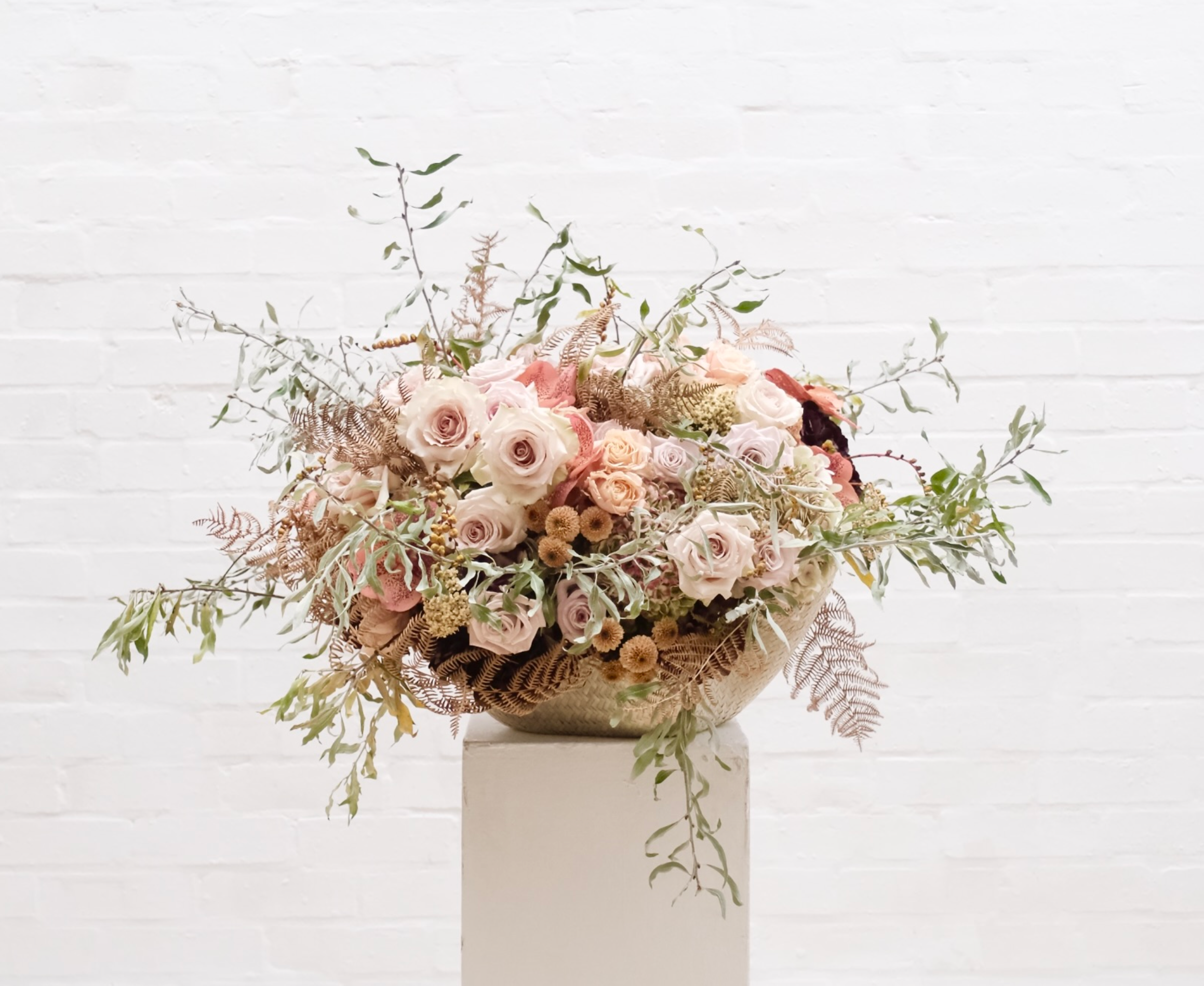
Sometimes one change is enough
When we’re looking for something new, there can be a temptation to change everything at once. A completely different flower palette, a new technique, a strange vessel, a complicated mechanic.
But you don’t necessarily need to.
Sometimes changing one thing is enough.
Take a design you know well and ask what would happen if you altered the proportion ever so slightly. What if the flowers became much taller than you would normally make them, or sat much lower? What if one side carried more visual weight than the other? What if the vessel became an important part of the composition rather than something you tried to disguise? What if you reduced the colour palette rather than expanded it, or used an ingredient you normally think of as supporting material and allowed it to become the main event?
They're quite small questions, but they can lead you somewhere completely different.
Learn from a design without copying it
This is something I return to again and again when I teach.
When you look at somebody else’s work, the most useful question often isn’t how can I make that? It is what can I take from this?
Maybe it’s a mechanic, a particular relationship between two colours, an unusual approach to proportion, the way a branch changes the line of an arrangement, the way a vessel has been used, or perhaps it's just an idea that makes you want to experiment with something you wouldn’t normally choose.
That's much more valuable than creating a perfect copy... because the aim shouldn’t be to become better at making somebody else’s work. It should be to develop more possibilities for your own and build on your own signature style.
A little exercise to try
How about the next time you’re creating, choose something familiar. It could be a basket, a vase, a bowl, a bouquet or a table arrangement, and before you begin, ask yourself a few extra questions.
What could I exaggerate? What could I simplify? What could I use differently? What could I remove? What would happen if I changed the proportion? What would make this feel more like me?
You don’t have to act on every answer, of course you don't, but maybe just pay attention to what comes up, because sometimes the most useful creative shift isn’t discovering something entirely new. It’s noticing a possibility in something you thought you already knew.
And that, I think, is where some of the most interesting ideas begin.
But wherever you’re learning, the principle is the same. Don’t just ask yourself what you can make. Ask yourself: what can you do with the familiar?
Artist. Educator. Writer. Broadcaster.


